Our Menu:
Curried parsnip, pumpkin and apple soup. Chopped walnut and apricot garnish.
Roast lamb with mint jelly
Roasted potatoes, carrots, onions and parsnip and steamed cauliflower, brussel sprouts and broccoli.
Hot fruit compote with Greek yoghurt creme fraiche.
Sterling 2006 merlot.
Well here we are - at critical mass. Breaking point. The last straw. I went to see my cardiologist yesterday, and his gift to me was that I am, healthwise, at a 'dangerous' place (his words - not mine. God knows - not mine.) The arrhythmia I had prior to the stent insertion and angioplasty last year has gotten no worse - but neither has it improved. My cholesterol is half what it was 5 years ago - and in fact within the recommended levels. But since I have a massive stent and a degree of heart disease, my LDL needs to be another 50 points lower still. Also, my HDL has dropped about 40% (not good) and my glucose has actually risen. My vitamin D is, literally, almost non-existent and my C Reactive protein levels are, as ever, ridiculously high. This may be significant or it may mean nothing at all. I have arthritis, so a CRP test is always going to be a blunt tool where I'm concerned. It's not a great result, tho, at a time when I could do with a great result...
At age 51, with 2 parents who died in their 50's, I am at a critical point in my life. I'm exhausted ALL the time, I have a lump in my thyroid, and I am a long way from home. What I'd like to do is get into bed, pull the covers over my head, and hide. What I'm going to do is try to take this mother by the throat and beat it to a pulp. I decided to start with Thanksgiving.
My intial goal is to lose 30lbs, drop my LDL 20 points and raise my HDL by 5. That's my goal. My secondary goal is to try to get a smile out of my cardiologist. Neither of these things is easy.
So I made my Thanksgiving menu with a goal to not dying. To be honest, if I had to say what my real goal was, it would be to avoid premature death and to see 80. I will settle for 70. If I don't make 60 - as neither of my parents did - I will be pissed. I gave up smoking many moons ago and gave up dairy in anything except minor doses a year ago, and completely (except for major holidays) a week ago. There should be some pay back for this. And God knows, I miss salt.
The average American consumes approximately 4500 calories and 200gms of fat on Thanksgiving. I decided I would not be part of that statistic. Consequently, our menu was highly fruit and vegetable based and the dairy topping to our fruit was predominantly fat free yoghurt. There was a very little olive oil in the soup, and a spray of olive oil on the roast veges, but otherwise the menu was cooked without added fats. I calculated the whole meal, and there was 17 grams of added fat, along with whatever fat was in the lamb. My lamb serving was 5oz and I removed anything visible and white, so I think it's looking good for a low fat day. Breakfast was oatmeal and I had a coffee with soy creamer in there somewhere, so all up, I think we nailed the whole fat thing this Thanksgiving. I'm not sure exactly what the calorie count was, but I can guarantee that we didn't pass our daily allowance and we were nowhere near 4500.
Was it a little dull? Yes. I spent whole minutes thinking longingly of cheese sauce and anything made from processed flour. But at this point in my life, the only bird I really crave is the one I wish to give my doctor when he is finally forced to say "My goodness, Kareyn! These figures are GREAT!"
Warmest Thanksgiving wishes to you all and may God grant you a happy, healthy year ahead.
Thursday, November 24, 2011

Monday, March 14, 2011
Vote for Dapple!
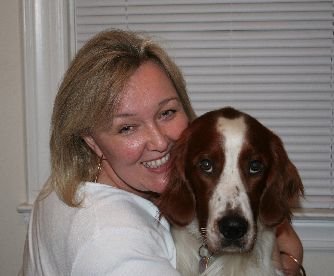
Marcia Leeder Photography is having a photography competition for dogs and their female-only owners. Given that I own one of the worlds most gorgeous canines, who happens to be a deaf rescue dog, I decided to enter.
The competition is through Facebook only and here's the link:
http://apps.facebook.com/contestshq/contests/103022/voteable_entries/17538342?ogn=facebook
If you log onto FB and go to this page, it will firstly ask you to allow the app. Click 'allow' (this takes about 2 seconds), and it will then take you straight to Dapple's voting page. You have to scroll down an inch or two to see her large photo (and mine - sheesh!) and to the right of that is a green button which says 'Vote Now'. Click on that, and it will turn automatically into 'I Voted'. If it doesn't switch to 'I Voted', hit it again!
Voters can vote once every 24 hour period; ie if you vote at 10am, you can't vote again till 10:01am the next day. A full 24 hours has to pass!
It's a great prize, but will in fact cost the winner a lot of money as transport and accommodation are *not* part of the prize and will need to be paid for by the owner. But this is an opportunity for me to shine one small spotlight on the precious dogs that are abandoned in such appalling numbers, and the rescue organizations that take them in.
Please vote for Dapple! She's a wonderful little dog, and she deserves her 15 minutes of fame. Thanks everybody,
Yours humbly,
K.E. Stapylton
The competition is through Facebook only and here's the link:
http://apps.facebook.com/contestshq/contests/103022/voteable_entries/17538342?ogn=facebook
If you log onto FB and go to this page, it will firstly ask you to allow the app. Click 'allow' (this takes about 2 seconds), and it will then take you straight to Dapple's voting page. You have to scroll down an inch or two to see her large photo (and mine - sheesh!) and to the right of that is a green button which says 'Vote Now'. Click on that, and it will turn automatically into 'I Voted'. If it doesn't switch to 'I Voted', hit it again!
Voters can vote once every 24 hour period; ie if you vote at 10am, you can't vote again till 10:01am the next day. A full 24 hours has to pass!
It's a great prize, but will in fact cost the winner a lot of money as transport and accommodation are *not* part of the prize and will need to be paid for by the owner. But this is an opportunity for me to shine one small spotlight on the precious dogs that are abandoned in such appalling numbers, and the rescue organizations that take them in.
Please vote for Dapple! She's a wonderful little dog, and she deserves her 15 minutes of fame. Thanks everybody,
Yours humbly,
K.E. Stapylton
Sunday, January 2, 2011
Happy New Year!
"Despite all the wishing in the world, you can never be anyone other than who you are. Mimicking others will not help. Instead, find the trails and pathways in your own character, and follow them - persistently, relentlessly, fearlessly - beyond what you've accepted as 'reasonable boundaries'. You are not limited by your own abilities - rather, you have not begun to explore yourself. The space in your soul is an untapped wilderness; look to the horizon! Go beyond the places you've always known. It's not who you are which is extraordinary - it's how far into your own uniqueness you're prepared to travel."
Welcome to 2011. May this year see a fuller exploration of who we are, a more fearless quest into our own abilities, and a stronger embrace of our commitment to this world and our belief that we can make a difference,
Yours with unshaken faith,
K.E. Stapylton
Welcome to 2011. May this year see a fuller exploration of who we are, a more fearless quest into our own abilities, and a stronger embrace of our commitment to this world and our belief that we can make a difference,
Yours with unshaken faith,
K.E. Stapylton
Tuesday, November 9, 2010
For Everyone Who's Ever Made A Mistake...
Welcome.
I looked in the mirror today and had an overwhelming sense of time passing. That happens to me almost continuously now – a sense that time is running out and the best, or at least the majority, of my life is behind me. The youth, the ability to direct my life’s path – gone. Where I am now is who I am and the whole thing equals what I’ve become and the legacy I’ll leave, which is…
What?
When I was young I let myself off the hook often for my mistakes, feeling that my life was just starting and there were plenty of years to define who I was. The mistakes would get overwhelmed with the successes, surely? But then I hit adulthood, and I started to feel that my mistakes were of more monumental proportions; the hurts I caused were more severe, the choices more indelible, the relationships I was losing – my mother, my father - more and more substantial and irretrievable. By the time I reached middle age I had regret. Not just minor disappointments, but big, serious opportunities lost and life choices I’d give years off my life to undo. I’d made mistakes, done things wrong, broken things I’d valued to such a degree that I felt the hope and possibility of youth slipping away. By age fifty, I had sorrow, guilt, and at least some degree of all the major negative emotions that come with getting it wrong and screwing it up. I looked at people who had lived safer, ‘cleaner’ lives, and kicked myself daily for all the stupid mistakes I’d made.
And I can’t undo it. I’ll never be fresh-faced, unsullied, naïve or innocent ever again. I’ve told too many lies, spoken too many harsh words, broken too many promises to ever be that girl again. And there’s tread on these tires and on this face. Faster and faster I am turning from the young, fertile woman to the crone – that female figure in Shakespearean literature, devoid of promise, who has been beaten down by life and loss, bad choices and inner darkness. My life is sliding past and I can't stop it, and I have yet to make my mark for good in this world.
I suspect others feel like this – especially other women. That sense of panic – of terror – that ‘it’s all slipping away’. But nobody says it. We’re all so busy trying to convey a sense of success, a sense of contentment. At the very least we portray ourselves as domestic martyrs, wives and mothers worn out through trying so hard, making such an effort, for family, friends, or our community. A sense of being 'good people'. Nobody wants to say “I blew it. I had one life and I’ve screwed it up.”
Well this is my confession; I didn’t work hard enough, I wasn’t honest enough, or loyal enough. I was too lazy, too self indulgent, too selfish. In the continual scrambling to get to a place of ‘ok’ – of ‘safe’ - I missed being the best I could be - or perhaps much good to this world at all.
I don’t know – and will never know – what I could have become or what I could have achieved had I put my head down and truly tried, had I worked out my goal and gone straight towards it, deviating neither to the left hand nor to the right. That dream is dead and I will never know, and I am overwhelmed with regret and panic when I see the sand in my personal hour glass running away without pause and me being no closer to reaching some identifiable, valuable destination. No success, no definition, no sense of “I did this and this is who I am.” I’ve heard doctors say that it’s almost impossible to get an unhealthy person to change their life habits and that the dependence this society has on medication is because people simply won’t lose weight, stop smoking or drinking, take up exercise and adopt a truly healthy lifestyle. I’ve heard those same doctors say that the one window of opportunity they have to make people change is directly after their first heart attack; that that period of time represents the one open door for their patients to move from ‘here’ to ‘there’. Well, middle age was my emotional heart attack. It was my crisis of identity. This is my now or never moment.
Afraid of taking a leap, I have hovered on the precipice of indecision for decades wondering what I should DO with my life – till that life has almost passed me by. Fifty may not seem old to some, but my parents died at ages 52 and 58, so this is a significant decade for me. Part of me wants to stay frozen, like a rabbit staring into the oncoming headlights. But something else in my heart has stirred, which whispers in my ear “Do it now, Kareyn. Do it NOW.”
I have been sure of two things in my life; that I love Jesus and that I am supposed to write. Be it books, blogs, poems or letters, as sure as I am of my religion, I’m sure my gift is with words and that words are powerful. The pen truly is mightier than the sword. So to this end I thank God daily for this gift and pick up my ‘pen’ and write. I have three more books to go in the Prism series, one coffee table book to write with a friend, and then my time will perhaps be my own, to blog, to write poems and stories for little children – simply to add joy and innocence to the world. I have a passion also for animals in pain - emotional or physical – and I’m doing what I can to raise awareness on the issues associated with their plight. Words are my gift, and I’m trying to use them judiciously, sparingly, accurately, healingly, joyfully, and quickly.
Will it be enough? Will I feel as though the contribution made will justify my existence, or even balance out the mistakes I’ve made and the black marks I’ll leave on this world? I feel as though I’m trying to shift a mountain with a teaspoon while somebody with a dump truck continually deposits loads of dirt and rubble on top of its peak. Will I ever make a difference? Is it even possible?
Underneath the panic, underneath the feelings of failure, speaks a still, quiet voice:
“Dig, Koo. Dig.”
“Now faith is the assurance of things hoped for, the conviction of things not seen. For by it the men of old received divine approval.….These all died in faith, not having received what was promised, but having seen it and greeted it from afar, and having acknowledged that they were strangers and exiles on the earth. For those who say such things make it plain that they are looking for a homeland, and if they had in mind the country from which they went out, they would have had a chance to return. But as it is, they desire a better country, that is, a heavenly one. Therefore God is not ashamed to be called their God, for he has prepared for them a city.”
Hebrews 11: 1, 2, 13-16.
I looked in the mirror today and had an overwhelming sense of time passing. That happens to me almost continuously now – a sense that time is running out and the best, or at least the majority, of my life is behind me. The youth, the ability to direct my life’s path – gone. Where I am now is who I am and the whole thing equals what I’ve become and the legacy I’ll leave, which is…
What?
When I was young I let myself off the hook often for my mistakes, feeling that my life was just starting and there were plenty of years to define who I was. The mistakes would get overwhelmed with the successes, surely? But then I hit adulthood, and I started to feel that my mistakes were of more monumental proportions; the hurts I caused were more severe, the choices more indelible, the relationships I was losing – my mother, my father - more and more substantial and irretrievable. By the time I reached middle age I had regret. Not just minor disappointments, but big, serious opportunities lost and life choices I’d give years off my life to undo. I’d made mistakes, done things wrong, broken things I’d valued to such a degree that I felt the hope and possibility of youth slipping away. By age fifty, I had sorrow, guilt, and at least some degree of all the major negative emotions that come with getting it wrong and screwing it up. I looked at people who had lived safer, ‘cleaner’ lives, and kicked myself daily for all the stupid mistakes I’d made.
And I can’t undo it. I’ll never be fresh-faced, unsullied, naïve or innocent ever again. I’ve told too many lies, spoken too many harsh words, broken too many promises to ever be that girl again. And there’s tread on these tires and on this face. Faster and faster I am turning from the young, fertile woman to the crone – that female figure in Shakespearean literature, devoid of promise, who has been beaten down by life and loss, bad choices and inner darkness. My life is sliding past and I can't stop it, and I have yet to make my mark for good in this world.
I suspect others feel like this – especially other women. That sense of panic – of terror – that ‘it’s all slipping away’. But nobody says it. We’re all so busy trying to convey a sense of success, a sense of contentment. At the very least we portray ourselves as domestic martyrs, wives and mothers worn out through trying so hard, making such an effort, for family, friends, or our community. A sense of being 'good people'. Nobody wants to say “I blew it. I had one life and I’ve screwed it up.”
Well this is my confession; I didn’t work hard enough, I wasn’t honest enough, or loyal enough. I was too lazy, too self indulgent, too selfish. In the continual scrambling to get to a place of ‘ok’ – of ‘safe’ - I missed being the best I could be - or perhaps much good to this world at all.
I don’t know – and will never know – what I could have become or what I could have achieved had I put my head down and truly tried, had I worked out my goal and gone straight towards it, deviating neither to the left hand nor to the right. That dream is dead and I will never know, and I am overwhelmed with regret and panic when I see the sand in my personal hour glass running away without pause and me being no closer to reaching some identifiable, valuable destination. No success, no definition, no sense of “I did this and this is who I am.” I’ve heard doctors say that it’s almost impossible to get an unhealthy person to change their life habits and that the dependence this society has on medication is because people simply won’t lose weight, stop smoking or drinking, take up exercise and adopt a truly healthy lifestyle. I’ve heard those same doctors say that the one window of opportunity they have to make people change is directly after their first heart attack; that that period of time represents the one open door for their patients to move from ‘here’ to ‘there’. Well, middle age was my emotional heart attack. It was my crisis of identity. This is my now or never moment.
Afraid of taking a leap, I have hovered on the precipice of indecision for decades wondering what I should DO with my life – till that life has almost passed me by. Fifty may not seem old to some, but my parents died at ages 52 and 58, so this is a significant decade for me. Part of me wants to stay frozen, like a rabbit staring into the oncoming headlights. But something else in my heart has stirred, which whispers in my ear “Do it now, Kareyn. Do it NOW.”
I have been sure of two things in my life; that I love Jesus and that I am supposed to write. Be it books, blogs, poems or letters, as sure as I am of my religion, I’m sure my gift is with words and that words are powerful. The pen truly is mightier than the sword. So to this end I thank God daily for this gift and pick up my ‘pen’ and write. I have three more books to go in the Prism series, one coffee table book to write with a friend, and then my time will perhaps be my own, to blog, to write poems and stories for little children – simply to add joy and innocence to the world. I have a passion also for animals in pain - emotional or physical – and I’m doing what I can to raise awareness on the issues associated with their plight. Words are my gift, and I’m trying to use them judiciously, sparingly, accurately, healingly, joyfully, and quickly.
Will it be enough? Will I feel as though the contribution made will justify my existence, or even balance out the mistakes I’ve made and the black marks I’ll leave on this world? I feel as though I’m trying to shift a mountain with a teaspoon while somebody with a dump truck continually deposits loads of dirt and rubble on top of its peak. Will I ever make a difference? Is it even possible?
Underneath the panic, underneath the feelings of failure, speaks a still, quiet voice:
“Dig, Koo. Dig.”
“Now faith is the assurance of things hoped for, the conviction of things not seen. For by it the men of old received divine approval.….These all died in faith, not having received what was promised, but having seen it and greeted it from afar, and having acknowledged that they were strangers and exiles on the earth. For those who say such things make it plain that they are looking for a homeland, and if they had in mind the country from which they went out, they would have had a chance to return. But as it is, they desire a better country, that is, a heavenly one. Therefore God is not ashamed to be called their God, for he has prepared for them a city.”
Hebrews 11: 1, 2, 13-16.
Wednesday, November 3, 2010
I, The Consumer - One woman's refusal to accept violence against women as entertainment.
For a long time now I have considered writing a post about the treatment of women in the media. I’ve put it off because I don’t want to be branded a zealot, a weirdo, a ‘pinko liberal commie bastard’, a ‘typical hysterical woman’, or anything outside the boundaries of what’s normal and socially acceptable female behavior.
But it occurs to me now that what’s normal and accepted is exactly what’s wrong. It’s exactly what I want to stand against. So here’s me, leaping the barricades of mainstream behavior and baring my chest (or my back, for the more cowardly) and speaking against the great Nameless Faceless They – the mainstream media (those elitist bastards!) (NB tongue in cheek nod of the head in the direction of Alaska and its most famous export).
Unless you’re blind or don’t own a tele, you’ve probably noticed the huge upswing recently in police/crime/detective shows. Crime, its detection and punishment as a form of entertainment, is on a seemingly exponential increase in mainstream media, and the vast majority orbits around crime against women. Call me old fashioned – heck, just call me old! – but these days, I’ve found myself sitting - unmoving - through things on the television I would never have seen thirty years ago and would have been outraged by if I had. I’m not entirely comfortable sitting through them now; I feel myself looking away, or feeling embarrassed if I’m watching them with somebody else. Somewhere, deep inside, I know – this is wrong. Women being raped, murdered, tortured, drugged, forced into prostitution, hit or abused in any way is not acceptable. But it’s EVERYWHERE – and I’ve learnt to suppress my own discomfort and accept it as a genuine part of common plot structure on tv.
And yet, this is not ok. In fact, this is a very, very, long way from ok. When I did some post graduate training in the area of dispute resolution, I remember having members from the police force come and speak to us about crisis negotiation. They told us, and research later supported this in my own experience, that the most effective way of decreasing stress in any situation is to role play it. Role playing stressful events multiple times was the most effective way – in fact the only reliable means – of decreasing the stress associated with that same event when it occurred in reality. Numerous reports have been produced over recent years finding that violent video games lead to a deadening of sensitivity – of conscience, if you will - in some players to those same crimes being committed in real life. "But it's not real!" is no longer an adequate defense against what must be seen as gateway behavior. My firm belief is that continually seeing women portrayed as victims leads to an acceptance in the real world of women as legitimate targets of abuse. In other words, it deadens the shock. We’re no longer appalled and, while we find it sad and unacceptable, nobody seems to be standing up against the continual portrayal of women as punching bags.
But the effect has been more widely spread. I spend a lot of time reading what’s on the internet. In fact, my friends often joke that – if it’s on the internet, I’ll either know it, have read it, or be able to point you towards it. And what I see in entertainment blogs is women being insulted in repulsive, verbally offensive terms if they deviate to any degree from what the blog commenter thinks is less than perfect. I’ve seen some of the most beautiful women in the world categorized as ‘dogs’ or worse; America Ferrera, Kim Kardashian, Jennifer Lopez, Jennifer Aniston, Jennifer Love Hewitt (anyone whose name is Jennifer, apparently!), Uma Thurman, Demi Moore, any woman more than 110 lbs, or less than 110 lbs, or too short, or too tall, or not enough to the liking of whichever man is writing the comment is fair game to be condemned as ugly and sexually unacceptable. We seem to have reached a stage where women are valued primarily for their sexual allure – a completely subjective and ephemeral thing – and pilloried if failing to make the grade. These women have their bodies discussed and ranked in intimate, descriptive detail, by men they’ve never met and who they’d never date in a thousand years. And yet, in that instant – in that snapshot of internet culture – women are pushed down into the role of valueless beings save for any sexual service they are able to render.
I am aware that many men treat women this way due to their own insecurities. But when women are insulted, patronized, passed over for promotion, bumping into the glass ceiling, harassed in the press, their places of business or leisure, when they’re hit, ridiculed, assaulted, looked down on by a culture which has been allowed to form simply because from the beginning of time one gender has a little greater muscle mass, there is SOMETHING WRONG. And when we, as people, ignore it or, worse still, allow it to become a form of entertainment – a part of the general cultural landscape – it’s time to pull our heads out of the sand, shake them HARD, and take a look at who we are.
But do we? On the whole – no. As women, we so often play the game. We buy into the culture and ‘try to compete from within’ – which is euphemistic for ‘being unwilling to exist outside’. As women, we often seem so desperate to be loved and accepted, we will sell our souls in an attempt not to be part of The Great Unloved – those unpartnered, or socially, relationally unchosen. I’ve seen the Facebook pages of young women where they’re made fun of and verbally debased by their own male friends – and they accept this because “that’s how everyone talks these days, Kareyn!” And then these same young women trot meekly behind these young men, hoping to be asked out, chosen, picked. They spread their legs, squash their own abilities and suppress their own views – all because they’re afraid of being alone or of having to fend for themselves. They embrace their own weakness and use it as a form of seduction, never seeming to notice that they’re writing checks for their own debasement.
Women, take a long, hard look at your life choices and actions, and see in what way you’ve accepted an oppressive culture. Speaking out against it won’t be popular, I’m sure. But find your voice, and say ‘no more’. We don’t need to make ourselves less so we can be deemed pretty or popular or acceptable or loved. We need to find who we are, in our strongest, most talented, individual selves, and be that. We are more than sources of sexual satisfaction or a means for some men to feel better about themselves by making us feel worse.
So tonight, let's look more closely at what we’re watching on television or at the theater. If that show or movie is not portraying women as strong, respect-worthy individuals, let's vote with our feet. We are the consumer. We control advertising, ratings, production. Let’s use the media to educate that we are strong and valuable and that violence is not ok. Let’s make hitting a woman no longer a form of entertainment. Let’s return it to the realm of 'horrific' and 'appalling' and totally, utterly unacceptable.
We are not weak. We are equal.
But it occurs to me now that what’s normal and accepted is exactly what’s wrong. It’s exactly what I want to stand against. So here’s me, leaping the barricades of mainstream behavior and baring my chest (or my back, for the more cowardly) and speaking against the great Nameless Faceless They – the mainstream media (those elitist bastards!) (NB tongue in cheek nod of the head in the direction of Alaska and its most famous export).
Unless you’re blind or don’t own a tele, you’ve probably noticed the huge upswing recently in police/crime/detective shows. Crime, its detection and punishment as a form of entertainment, is on a seemingly exponential increase in mainstream media, and the vast majority orbits around crime against women. Call me old fashioned – heck, just call me old! – but these days, I’ve found myself sitting - unmoving - through things on the television I would never have seen thirty years ago and would have been outraged by if I had. I’m not entirely comfortable sitting through them now; I feel myself looking away, or feeling embarrassed if I’m watching them with somebody else. Somewhere, deep inside, I know – this is wrong. Women being raped, murdered, tortured, drugged, forced into prostitution, hit or abused in any way is not acceptable. But it’s EVERYWHERE – and I’ve learnt to suppress my own discomfort and accept it as a genuine part of common plot structure on tv.
And yet, this is not ok. In fact, this is a very, very, long way from ok. When I did some post graduate training in the area of dispute resolution, I remember having members from the police force come and speak to us about crisis negotiation. They told us, and research later supported this in my own experience, that the most effective way of decreasing stress in any situation is to role play it. Role playing stressful events multiple times was the most effective way – in fact the only reliable means – of decreasing the stress associated with that same event when it occurred in reality. Numerous reports have been produced over recent years finding that violent video games lead to a deadening of sensitivity – of conscience, if you will - in some players to those same crimes being committed in real life. "But it's not real!" is no longer an adequate defense against what must be seen as gateway behavior. My firm belief is that continually seeing women portrayed as victims leads to an acceptance in the real world of women as legitimate targets of abuse. In other words, it deadens the shock. We’re no longer appalled and, while we find it sad and unacceptable, nobody seems to be standing up against the continual portrayal of women as punching bags.
But the effect has been more widely spread. I spend a lot of time reading what’s on the internet. In fact, my friends often joke that – if it’s on the internet, I’ll either know it, have read it, or be able to point you towards it. And what I see in entertainment blogs is women being insulted in repulsive, verbally offensive terms if they deviate to any degree from what the blog commenter thinks is less than perfect. I’ve seen some of the most beautiful women in the world categorized as ‘dogs’ or worse; America Ferrera, Kim Kardashian, Jennifer Lopez, Jennifer Aniston, Jennifer Love Hewitt (anyone whose name is Jennifer, apparently!), Uma Thurman, Demi Moore, any woman more than 110 lbs, or less than 110 lbs, or too short, or too tall, or not enough to the liking of whichever man is writing the comment is fair game to be condemned as ugly and sexually unacceptable. We seem to have reached a stage where women are valued primarily for their sexual allure – a completely subjective and ephemeral thing – and pilloried if failing to make the grade. These women have their bodies discussed and ranked in intimate, descriptive detail, by men they’ve never met and who they’d never date in a thousand years. And yet, in that instant – in that snapshot of internet culture – women are pushed down into the role of valueless beings save for any sexual service they are able to render.
I am aware that many men treat women this way due to their own insecurities. But when women are insulted, patronized, passed over for promotion, bumping into the glass ceiling, harassed in the press, their places of business or leisure, when they’re hit, ridiculed, assaulted, looked down on by a culture which has been allowed to form simply because from the beginning of time one gender has a little greater muscle mass, there is SOMETHING WRONG. And when we, as people, ignore it or, worse still, allow it to become a form of entertainment – a part of the general cultural landscape – it’s time to pull our heads out of the sand, shake them HARD, and take a look at who we are.
But do we? On the whole – no. As women, we so often play the game. We buy into the culture and ‘try to compete from within’ – which is euphemistic for ‘being unwilling to exist outside’. As women, we often seem so desperate to be loved and accepted, we will sell our souls in an attempt not to be part of The Great Unloved – those unpartnered, or socially, relationally unchosen. I’ve seen the Facebook pages of young women where they’re made fun of and verbally debased by their own male friends – and they accept this because “that’s how everyone talks these days, Kareyn!” And then these same young women trot meekly behind these young men, hoping to be asked out, chosen, picked. They spread their legs, squash their own abilities and suppress their own views – all because they’re afraid of being alone or of having to fend for themselves. They embrace their own weakness and use it as a form of seduction, never seeming to notice that they’re writing checks for their own debasement.
Women, take a long, hard look at your life choices and actions, and see in what way you’ve accepted an oppressive culture. Speaking out against it won’t be popular, I’m sure. But find your voice, and say ‘no more’. We don’t need to make ourselves less so we can be deemed pretty or popular or acceptable or loved. We need to find who we are, in our strongest, most talented, individual selves, and be that. We are more than sources of sexual satisfaction or a means for some men to feel better about themselves by making us feel worse.
So tonight, let's look more closely at what we’re watching on television or at the theater. If that show or movie is not portraying women as strong, respect-worthy individuals, let's vote with our feet. We are the consumer. We control advertising, ratings, production. Let’s use the media to educate that we are strong and valuable and that violence is not ok. Let’s make hitting a woman no longer a form of entertainment. Let’s return it to the realm of 'horrific' and 'appalling' and totally, utterly unacceptable.
We are not weak. We are equal.
Wednesday, October 27, 2010
For Shannon and Luckiest Fiona - Joy Unbounded.
This week, an online friend of mine lost her beloved dog. I am aware that this holds a different level of import for all people. But for those of us, myself included, who have opened our hearts to our dogs as family members – as our children – this grief can be overwhelming.
I often wake in the night wondering how I will cope when the time comes for one of my three. Dixon, Dapple and Poppy have been beloved members of my family since the day they set their first precious paw through my front door and, while I know there must be love greater than I feel for these wonderful creatures, I struggle to conceive what that might be, or how I will cope with the pain of losing any of these treasured members of my household.
People involved with the animal world – most particularly the dog world of rescue or breeding – speak often of the Rainbow Bridge. We comfort each other over the loss of our dogs with the idea of a place on the other side of ‘here and now’ where owners will reunite with their departed pets who wait for them faithfully. To me, this place sounds like heaven. Perfection. Love in its fullest. When writing the books of Prism, I’ve tried to create a perfect world – the sort of world I would inhabit if I could create a world that reflected my own picture of perfection. Yet even in Prism, people die, families are separated and loved ones lost. Having recently finished Book 2, The Deeper Darkness, I am now about to commence Book 3 – Phantism – and during that book a sequence of loss will occur that will show the frailties that exist, even in Prism. Joy – bounded.
But what if I could create a world where we, and those we loved, lived forever? What if we knew joy – unbounded? Love unending, health unlimited and life eternal? What if? What if all the things we loved and valued were never lost, never broken, never sullied? What if I opened my eyes each morning to the most glorious red and white face in the entire world, the deepest brown eyes, the silkiest ears, and my face covered with canine kisses? What if the air was clean, the water pure, the view clear and sparkling, and my day filled with joy, laughter, and all the people I loved most in the world? Where is the world with no pain, no death and no separation? I want that world. I want that world with all my heart. And right at the very front – between the welcoming gates – I would place a bridge with a rainbow stretched from end to end that connected – not this life and the next – but, rather, now and now, with no sense of separation. Joy – unbounded.
What if?
“Let not your heart be troubled; you believe in God, believe also in me. In my Father’s house are many mansions; if it were not so, I would have told you. I go to prepare a place for you. And if I go and prepare a place for you, I will come again and receive you to myself; that where I am, there you may be also.” John 14:1-3
I often wake in the night wondering how I will cope when the time comes for one of my three. Dixon, Dapple and Poppy have been beloved members of my family since the day they set their first precious paw through my front door and, while I know there must be love greater than I feel for these wonderful creatures, I struggle to conceive what that might be, or how I will cope with the pain of losing any of these treasured members of my household.
People involved with the animal world – most particularly the dog world of rescue or breeding – speak often of the Rainbow Bridge. We comfort each other over the loss of our dogs with the idea of a place on the other side of ‘here and now’ where owners will reunite with their departed pets who wait for them faithfully. To me, this place sounds like heaven. Perfection. Love in its fullest. When writing the books of Prism, I’ve tried to create a perfect world – the sort of world I would inhabit if I could create a world that reflected my own picture of perfection. Yet even in Prism, people die, families are separated and loved ones lost. Having recently finished Book 2, The Deeper Darkness, I am now about to commence Book 3 – Phantism – and during that book a sequence of loss will occur that will show the frailties that exist, even in Prism. Joy – bounded.
But what if I could create a world where we, and those we loved, lived forever? What if we knew joy – unbounded? Love unending, health unlimited and life eternal? What if? What if all the things we loved and valued were never lost, never broken, never sullied? What if I opened my eyes each morning to the most glorious red and white face in the entire world, the deepest brown eyes, the silkiest ears, and my face covered with canine kisses? What if the air was clean, the water pure, the view clear and sparkling, and my day filled with joy, laughter, and all the people I loved most in the world? Where is the world with no pain, no death and no separation? I want that world. I want that world with all my heart. And right at the very front – between the welcoming gates – I would place a bridge with a rainbow stretched from end to end that connected – not this life and the next – but, rather, now and now, with no sense of separation. Joy – unbounded.
What if?
“Let not your heart be troubled; you believe in God, believe also in me. In my Father’s house are many mansions; if it were not so, I would have told you. I go to prepare a place for you. And if I go and prepare a place for you, I will come again and receive you to myself; that where I am, there you may be also.” John 14:1-3
Sunday, July 4, 2010
20 Things I've Learned From My Dog Dixon
Over the years, I've learnt that animals have their own way of communicating. My dog, Dixon, for example, speaks to me with his eyes and his actions as clearly as any person I know, and over the years, I've learnt to listen. In fact, Dixon has taught me quite a number of useful life lessons, and I thought I'd share them here. So here are...
20 Things I’ve Learnt From My Dog, Dixon
1) It’s only the idiot on the end of the lead who cares how expensive the collar is.
2) Treats are good – but nothing beats a walk in the park with someone you love.
3) If you manage to escape your backyard, the person who loves you will be thrilled when you come back. If their first words are “Bad dog!” go find another family to live with.
4) Communication is important – but at 3am, nobody cares what you have to say.
5) There’s nothing to be embarrassed about regarding physical functions.
6) Electric blankets are a gift from God.
7) If you’re stuck somewhere and you have to go to the toilet, don’t be too shy to tell somebody.
8) All things are better if they squeak. Even people.
9) I want what you have. I don’t know why. I just want it.
10) If someone growls at you, smile and show your tummy.
11) Getting your nose up someone else’s butt is not normally appreciated; no really DOES mean no.
12) Be prepared to do what your family tells you – about 1 in 3. They get such a charge out of it and I mean – really – how hard is it to ‘lay down’? The whole ‘roll over’, ‘fetch’ and ‘beg’ thing can be negotiated.
13) Nirvana starts in our house promptly every night at 7pm when Dad walks through the door.
14) If you look cute, even if you’re naughty, somebody will generally kiss you.
15) There is no benefit in making your bed.
16) If you nip, you’ll get attention. Just not necessarily the attention you want.
17) Exercise is not negotiable.
18) Sometimes, to scratch an itch, you have to get someone else to do it. In this situation, a nice lady with long nails is normally best.
19) Life is better if you’re part of a pack.
20) No matter how adorable you are, if you have Mom’s favourite shoe (gloves/wallet/project she’s working on) chewed up and hanging out your mouth, HIDE UNDER THE COFFEE TABLE.
20 Things I’ve Learnt From My Dog, Dixon
1) It’s only the idiot on the end of the lead who cares how expensive the collar is.
2) Treats are good – but nothing beats a walk in the park with someone you love.
3) If you manage to escape your backyard, the person who loves you will be thrilled when you come back. If their first words are “Bad dog!” go find another family to live with.
4) Communication is important – but at 3am, nobody cares what you have to say.
5) There’s nothing to be embarrassed about regarding physical functions.
6) Electric blankets are a gift from God.
7) If you’re stuck somewhere and you have to go to the toilet, don’t be too shy to tell somebody.
8) All things are better if they squeak. Even people.
9) I want what you have. I don’t know why. I just want it.
10) If someone growls at you, smile and show your tummy.
11) Getting your nose up someone else’s butt is not normally appreciated; no really DOES mean no.
12) Be prepared to do what your family tells you – about 1 in 3. They get such a charge out of it and I mean – really – how hard is it to ‘lay down’? The whole ‘roll over’, ‘fetch’ and ‘beg’ thing can be negotiated.
13) Nirvana starts in our house promptly every night at 7pm when Dad walks through the door.
14) If you look cute, even if you’re naughty, somebody will generally kiss you.
15) There is no benefit in making your bed.
16) If you nip, you’ll get attention. Just not necessarily the attention you want.
17) Exercise is not negotiable.
18) Sometimes, to scratch an itch, you have to get someone else to do it. In this situation, a nice lady with long nails is normally best.
19) Life is better if you’re part of a pack.
20) No matter how adorable you are, if you have Mom’s favourite shoe (gloves/wallet/project she’s working on) chewed up and hanging out your mouth, HIDE UNDER THE COFFEE TABLE.
Subscribe to:
Posts (Atom)